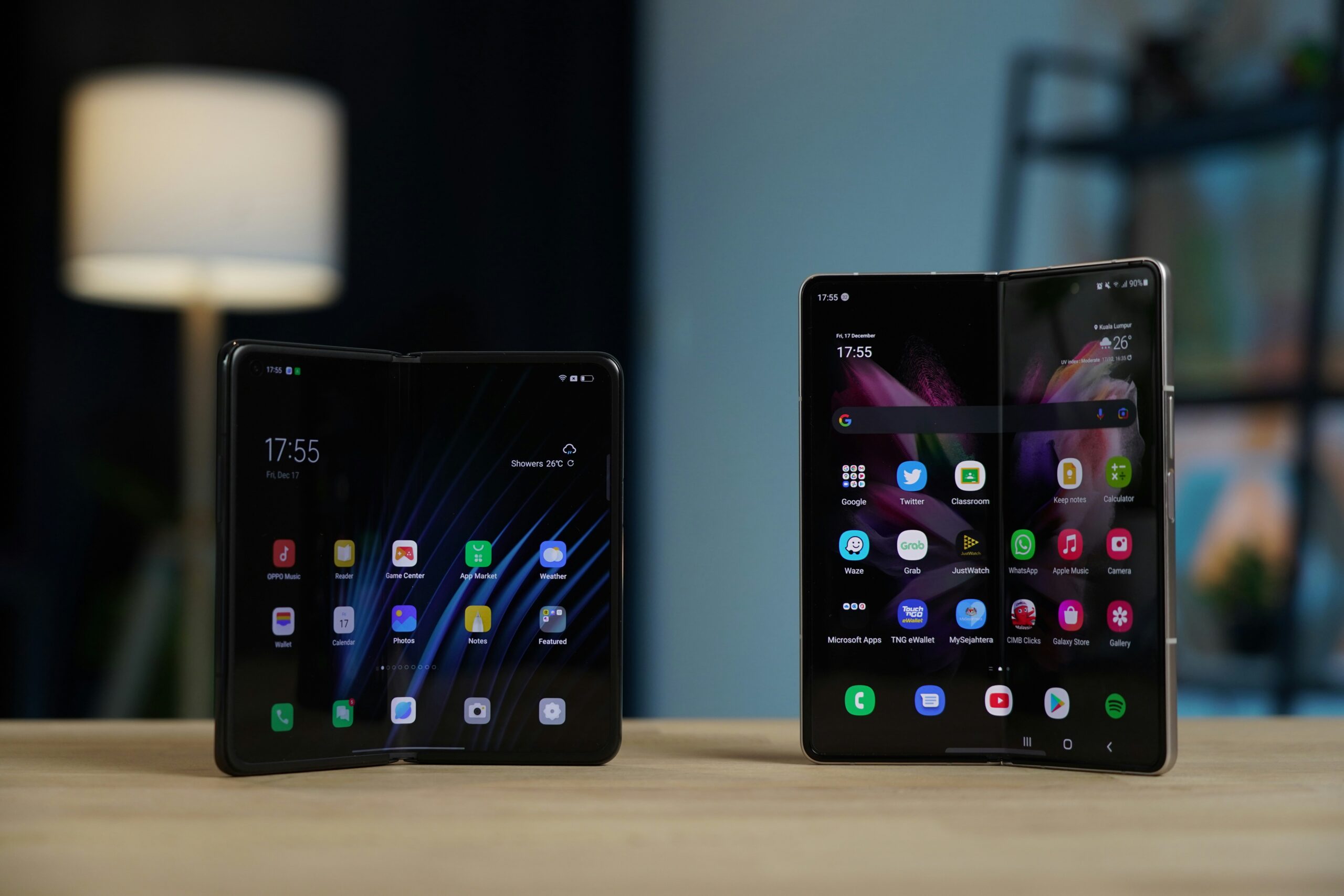
Imagine a book, it’s closed. Now open it. You probably pictured a portrait rectangle (taller than it is wide) when closed, and landscape rectangle (wider than it is tall) when open. That tends to hold true for most books, from coffee table books, to passports.
Despite this, after 5 years of iteration, Android foldables have settled on a vastly different form factor: A narrow portrait rectangle when closed (the same aspect ratio as a slab phone), that opens into an almost square, very slightly portrait rectangle. Why did they choose to go with this tall form factor instead of wide one that has proven itself over centuries of publishing?

Two words: app compatibility
Android apps are great on phones, but typically bad on tablets or any other form factor. If you tried to open an app designed for phones on a tablet, you would get black bars on either side, have the app rotate to align with the long edge, or have UI elements cropped outside of the display. It’s an at best awkward, at worst unusable experience. This is largely the reason why Android tablets haven’t taken off the same way iPads did.
On a wide foldable, these problems are glaringly obvious. The app might rotate to fit the landscape orientation, and if it doesn’t, the black bars will be huge, and UI elements are more likely to be cropped. Even when folded, the squatter aspect ratio isn’t ideal for phone apps. So you get a device that is a bad phone and an even worse tablet.
These problems are mitigated on a tall foldable. When closed, it works just like a phone. Apps behave the way they should. When opened, it’s still more portrait than landscape, so apps don’t rotate, the black bars aren’t as bad, and UI elements are less likely to be cropped. Any awkwardness can be remedied by having 2 apps run side by side, allowing each app to fit into its intended phone aspect ratio.
Google tried to make the wide foldable work with its first Pixel Fold. For its second generation, they decided to switch to the tall form factor and haven’t looked back since.
Why Apple will Succeed at Wide Foldables
Thanks to over a decade of iPad app development, the Apple ecosystem is full of apps optimized for landscape form factors. All these apps could be ported over to the iPhone Duo with minimal changes and work pretty well. In addition, Apple has the ability to influence app developers in a way no one else can. It’s a mix of brand perception, having a userbase willing to spend on software, and a history of consistently supporting their products.
As I’m writing this, developers are working on making their apps compatible with the iPhone Duo despite the fact that nobody can buy one yet. I doubt they are doing the same for the Galaxy Z Fold 8.
What can Android do about it?
At the risk of sounding like AI — The Galaxy Z Fold 8 is not a copycat product, it’s a pitch to app developers: “You’re already doing all this work to make your app compatible with the iPhone Duo, why not port it to Android foldables while you’re at it?” Google is rumored to be launching a wide foldable soon, and we’ll probably see the other Android companies do so too. This pitch might work to an extent, but it won’t be enough to sway most developers.
If the iPhone Duo is successful, the wide form factor will become the default. Because of the app compatibility issue, a wide foldable running Android will be a worse user experience, even if the hardware and first-party software were built to the same high standards. If they can’t compete on quality, Android companies will have to compete with quantity.
Right now, Android still owns the foldables market. They need to do everything they can to maintain their market share. They also need to show developers that they are serious about supporting their products, whether it’s software updates for existing products, or continuing product lines into the future. Maintaining a critical mass of users and committing to future investment is the only way to convince developers to support their products.
The alternative is a death spiral where users don’t want to buy Android foldables because the apps aren’t there and developers don’t want to create apps because the users aren’t there.
The SUV-cation of Phones
Growing up, the majority of cars on the roads were sedans and hatchbacks, with the occasional truck or SUV. Now its the other way round. People were willing to trade performance and fuel economy for feeling safer, riding higher, and having the ability to go off-road should the need arise.
For the last decade the value proposition for upgrading your phone has been “faster processor, longer battery life, better camera” and every year, people care about those things less. In time, more people will trade the better cameras on their slab phones for more screens on their foldables.
Today a foldable phone is a novelty for the rich. In 10 years, I predict the vast majority of new phones sold in the US will be foldable. With a shrinking slab phone market, and the tall foldable losing out to the wide form factor, Android might become less and less relevant. In a future where our default phone looks like an iPhone Duo, will we still have a meaningful choice of what operating system it runs on?
